
Experimental Agent Memory
An opt-in, experimental memory system that lets Ambient remember and reuse relevant context across turns — adapted from the open-source TencentDB-Agent-Memory project, stored locally in your workspace, and off by default.
Settings
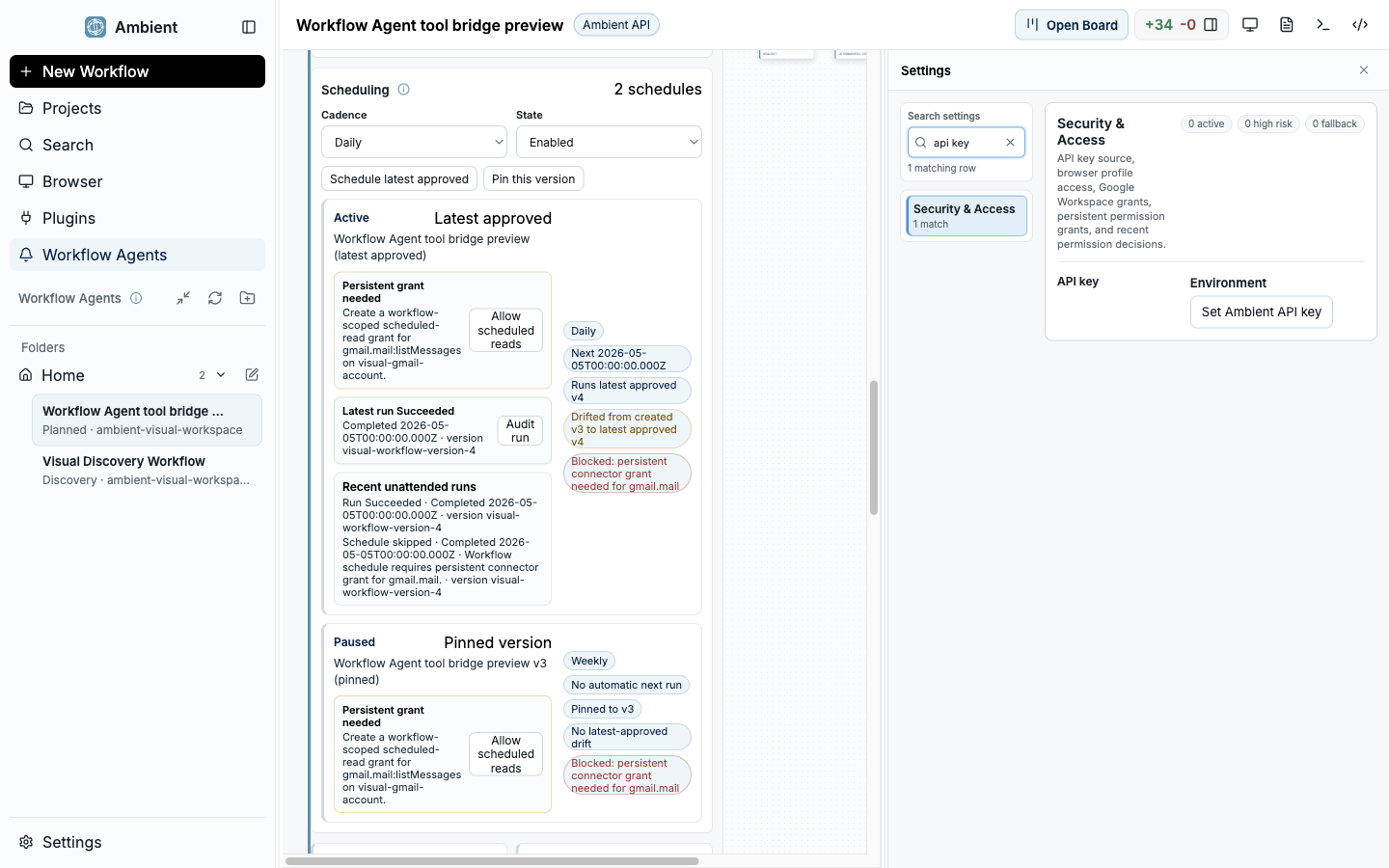
Settings search keeps provider, permission, and runtime configuration discoverable.
Memory that lives outside the transcript
Chat context is fragile: once a conversation is trimmed or a session ends, what the agent "knew" is gone. Agent Memory is an experimental system that keeps useful context in a durable store instead. Before each turn it recalls what is relevant; after each turn it captures what happened — so later work can build on earlier work without you re-explaining.
It is adapted from the open-source TencentDB-Agent-Memory project (TencentCloud), whose four-layer pipeline distills raw conversation into reusable facts, profiles, and task structure. Ambient wraps that engine behind its own host adapter, runs it workspace-local, and keeps it off by default while it is in development.
How a turn uses memory
Memory hooks into the agent loop at two points — a read before the model runs, and a write after it finishes. The store itself stays on your machine.
Recall, before the model answers
When memory is enabled for a thread, Ambient searches the store for context relevant to your message and prepends a bounded set of matches to the prompt — capped in size so it informs the model without flooding it.
Respond
The provider answers with that recalled context in view. Routing, approvals, and every other safeguard work exactly as they do without memory.
Capture, after the turn
The completed turn is written back to the store as a raw record, and higher-level extraction distills it into structured memory for future recall.
The four layers
The adapted pipeline organizes memory into four layers, from raw conversation up to task structure. Higher layers make recall sharper than a plain transcript search.
Raw turns
The verbatim record of each captured exchange — the source of truth everything else is derived from.
Facts
Structured, reusable facts extracted from conversation, so the agent recalls the point rather than the paragraph.
Profiles
Longer-lived conversation and preference profiles that persist across many turns.
Scenes
Task- and scene-level structure that ties related work together for sharper, situation-aware recall.
Turning it on
Agent Memory is experimental and off by default. You opt in deliberately, and you can scope it down to a single thread.
Enable the system
Memory is gated by an experimental flag and a Settings switch, so it never starts capturing anything until you turn it on.
Per-thread control
Each thread carries its own memory toggle. Keep most chats memoryless and enable memory only where continuity helps.
Optional local embeddings
Semantic recall can use a local embedding model run through Ambient's managed llama.cpp runtime — local-first, no content sent to the cloud to be remembered.
Inspect and delete
Built-in tools let you search, inspect, edit, and delete stored memories from chat. Memory you can see is memory you can correct.
Where your memories live
Privacy is a design constraint, not an afterthought. The store is workspace-local — a local SQLite database (with optional local vectors) under the workspace's .ambient directory. It is not shared between workspaces and is not synced to a cloud service in this phase. Because you can list and delete entries, and because the whole system is opt-in, you stay in control of what is retained.
What ships, and what is still planned
Honest scope: the local pipeline is functional today — recall, capture, the L0–L3 layers, optional local-embedding semantic search, short-term offload of large tool outputs, and inspect/edit/delete are all implemented behind the experimental flag. What is not here yet is a cloud-backed vector store, memory shared across workspaces, and graduation out of experimental status. That is why this page is labeled In Development: the building blocks work, but the system is still proving itself before it is on by default.
FAQ
Is memory on by default?
No. It is experimental and off by default, gated by a flag and a Settings switch, with a per-thread toggle on top. Nothing is captured until you opt in.
Does my conversation get sent somewhere to be remembered?
No. The store is workspace-local SQLite under .ambient, and semantic recall can run on a local embedding model. There is no cloud memory backend in this phase.
Can I see and remove what it remembered?
Yes. Built-in tools let you search, inspect, edit, and delete stored memories directly from chat, so you can audit and correct the store at any time.
How does this relate to durable goals?
Durable goals persist the plan and evidence for one objective; Agent Memory persists reusable context across many turns and tasks. They complement each other — see Durable Goal Loops.